Projects
AML queue
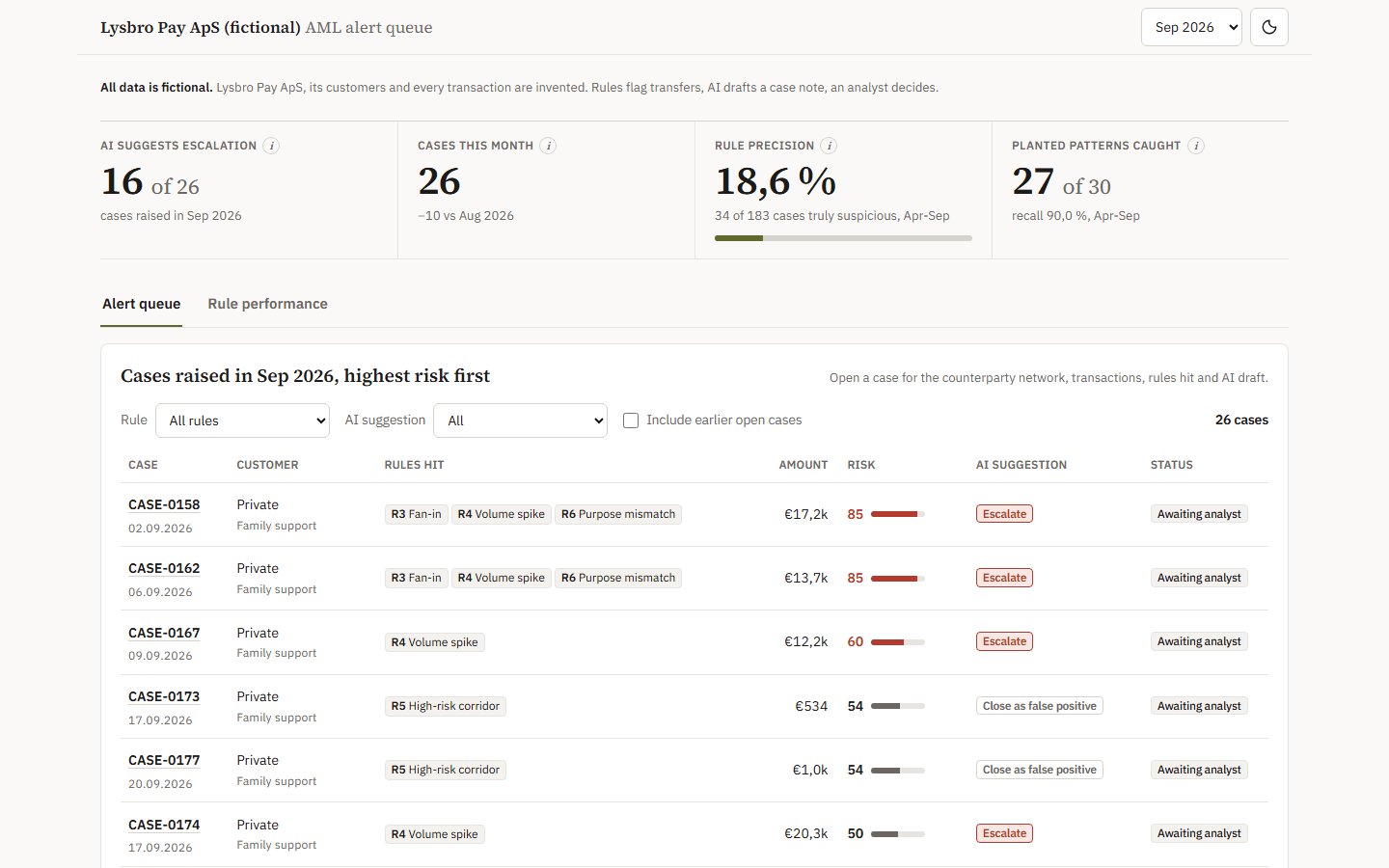
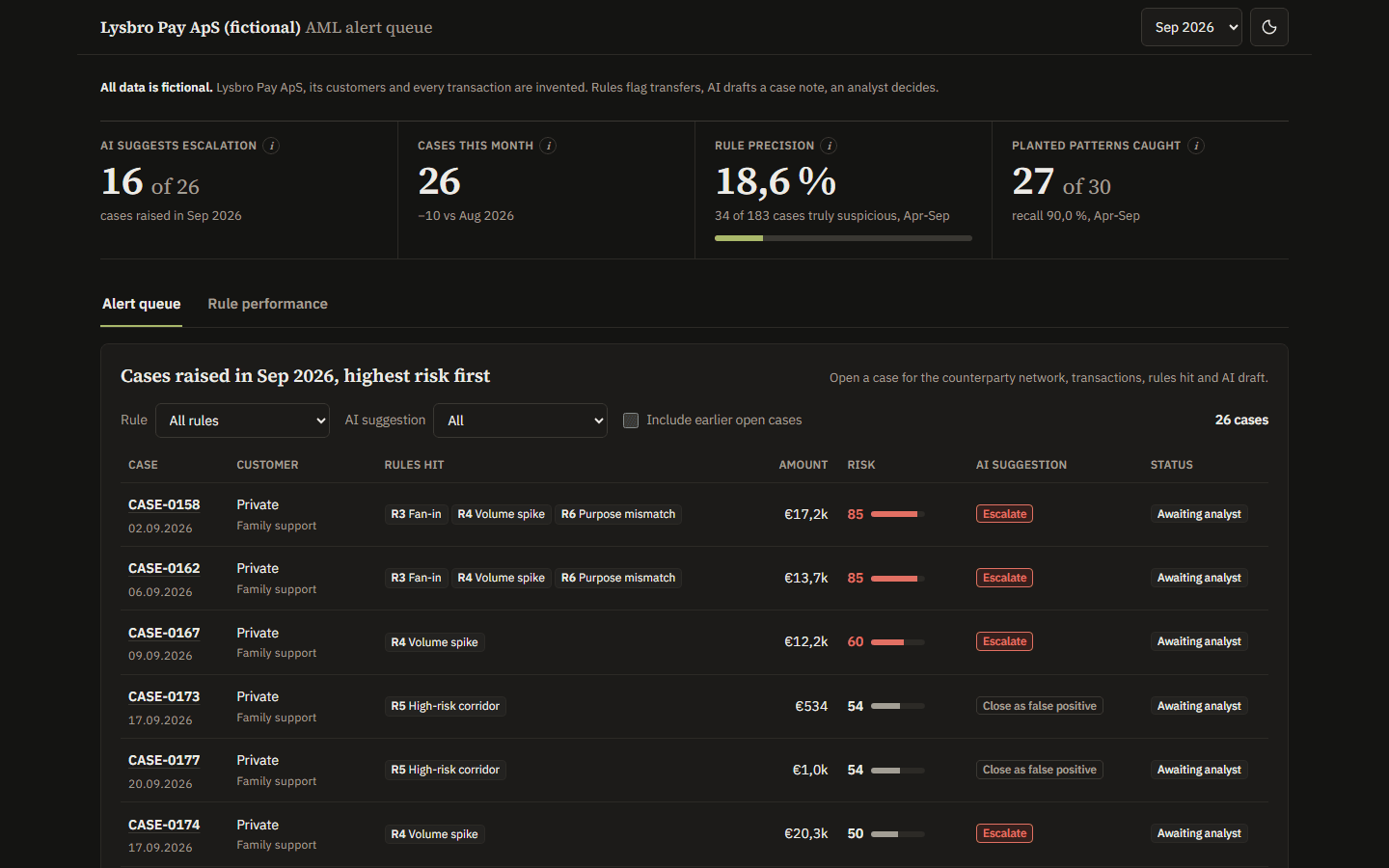
An AML alert queue for a fictional Danish payment company. Rules flag transfers, AI drafts a case note and suggests a next step, and an analyst decides.
For: Compliance, AML and risk teams
Data is fictional. Lysbro Pay ApS, its customers and every transfer are invented.
The problem
A payment company must watch its transfers for signs of money laundering. Rules catch behaviour that looks suspicious, but most alerts turn out to be ordinary. Analysts read every case to decide what to escalate.
What the dashboard shows
- Key figures for the selected month, including rule precision and planted patterns caught.
- The alert queue, sorted by risk score, with the rules hit and the AI suggestion.
- A drill-down per case: profile, declared purpose against actual behaviour, a timeline and the AI draft.
- Rule performance: cases per rule, split into truly suspicious and false positives.
Key findings
- The rules raised 183 cases. 34 were truly suspicious, a precision of 18,6 %.
- They caught 27 of the 30 planted customers (recall 90,0 %). The 3 misses were weak versions built to sit just under a threshold.
- Two rules make most of the false positives: volume spike (70) and high-risk corridor (58).
The AI part and how it was checked
For each case, Claude sees the profile, the rules hit, the triggering transfers and the 90 days before the alert. It does not see the name or anything after the case date. It suggests escalate or close. It never decides.
A script without AI checks every number and date. 134 of 183 drafts passed on the first attempt and 178 of 183 after retries.
Against the planted truth, the AI suggested escalating 30 of 34 truly suspicious cases. Reading only the cases it flags would mean 100 of 183 cases and 4 missed. So the AI orders the queue and does not close cases. Total cost was about USD 0,16.
What it does not do
- The data is synthetic. Two rules at 100 % precision are an artefact of how normal customers were generated.
- No analyst decisions exist. Precision and recall come from an answer key, and no time saving is claimed.
- One run with one prompt version. Variation between runs is not measured.
How it was built
Python, DuckDB with SQL views, the Claude API, Next.js and Recharts on Vercel.
Built with Claude Code.